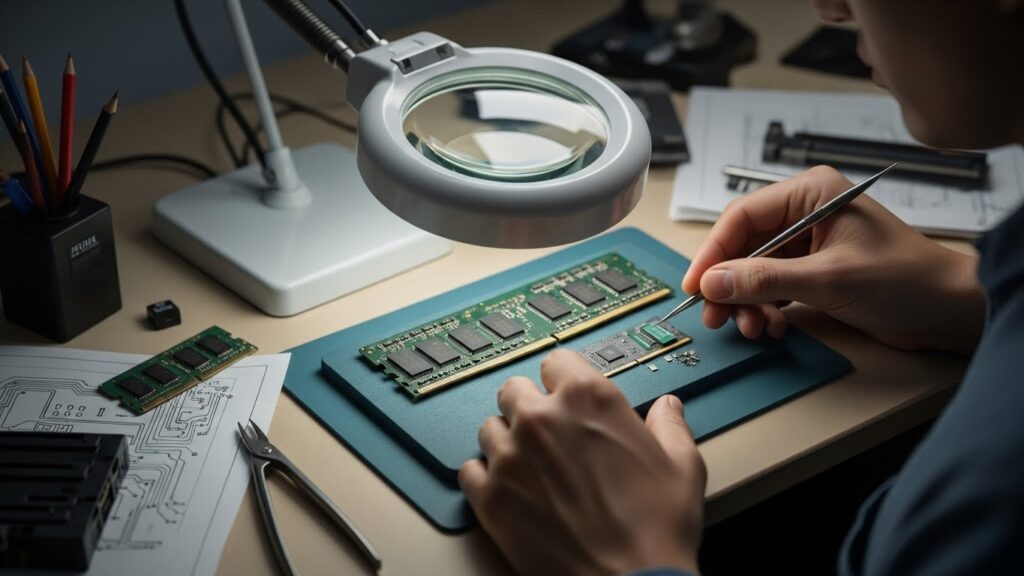
As the global DDR5 memory shortage continues to strain supply chains and drive prices upward, a small group of Russian PC hardware enthusiasts is exploring an extreme alternative: building DDR5 Memory RAM modules by hand.
The idea sounds outrageous at first, but according to those involved, creating functional DDR5 memory is theoretically possible — if you can source the components and have the skills to assemble them.
Why Anyone Would Build Their Own DDR5 RAM
DDR5 memory has faced recurring shortages due to:
- High demand from AI, servers, and next-gen PCs
- Limited manufacturing capacity
- Export restrictions and supply chain disruptions
For enthusiasts with access to components but limited access to finished consumer products, DIY RAM has become a thought experiment — and in some cases, a real project.
The motivation isn’t convenience. It’s necessity, curiosity, and technical challenge.
What “DIY DDR5 Memory” Actually Means
Despite the bold claims, building DDR5 RAM is not simple — just theoretically straightforward.
According to the enthusiasts involved, the basic requirements include:
- Empty DDR5 PCBs (printed circuit boards)
- Individual DDR5 memory chips
- Power management ICs (PMICs), which are mandatory on DDR5 modules
- SPD (Serial Presence Detect) chips for firmware data
- High-precision soldering equipment
- Deep knowledge of memory layouts and signaling
In short, you’re not “assembling” RAM — you’re manufacturing it at a microelectronics level.
The Biggest Challenge: DDR5 Complexity
DDR5 is significantly more complex than previous generations.
Key difficulties include:
- On-module power management (PMIC integration)
- Extremely tight signal tolerances
- Multi-layer PCB design
- SPD programming and firmware configuration
- Quality control and stability testing
Even small soldering imperfections can result in instability, boot failures, or total non-functionality.
This is why RAM is normally produced in clean-room factories — not garages.
“Easy” Only in Theory
Enthusiasts involved in the discussion emphasize that DIY DDR5 is “easy” only in the most technical sense.
If you already:
- Understand PCB design
- Have access to professional soldering tools
- Can source authentic DDR5 chips
- Know how to flash and configure SPD firmware
Then yes — you might be able to produce a working module.
For everyone else, this is far beyond hobbyist tinkering.
Legal and Practical Barriers
There are also serious non-technical obstacles.
Sourcing genuine DDR5 memory chips is difficult, as manufacturers typically sell them only to large partners. There are also concerns about:
- Counterfeit or recycled chips
- Unknown chip binning and quality
- Warranty and reliability
- System compatibility
Even if a DIY module boots, long-term stability is not guaranteed.
Why This Matters Beyond One Project
While DIY DDR5 RAM is unlikely to become mainstream, the discussion highlights a deeper issue: how fragile modern hardware supply chains have become.
When enthusiasts seriously consider manufacturing their own RAM, it shows how shortages and restrictions can push innovation — or desperation — to unusual extremes.
It also demonstrates how much modern computing depends on highly specialized, centralized manufacturing.
Is DIY RAM the Future? Probably Not.
Even the most optimistic supporters admit this is not a scalable solution.
DIY DDR5 will likely remain:
- A proof-of-concept
- A technical challenge for experts
- A niche experiment
Mass-produced memory will always be cheaper, more reliable, and safer for consumers.
Final Thoughts
Building DDR5 RAM by hand may sound absurd — and for most people, it is. But the fact that skilled enthusiasts are even discussing it seriously speaks volumes about today’s hardware ecosystem.
In an era of shortages and restrictions, some PC builders aren’t just waiting for supply to recover — they’re trying to out-engineer the problem entirely.
Even if DIY DDR5 never becomes practical, it’s a fascinating reminder of how far curiosity and technical skill can be pushed when access is limited.