

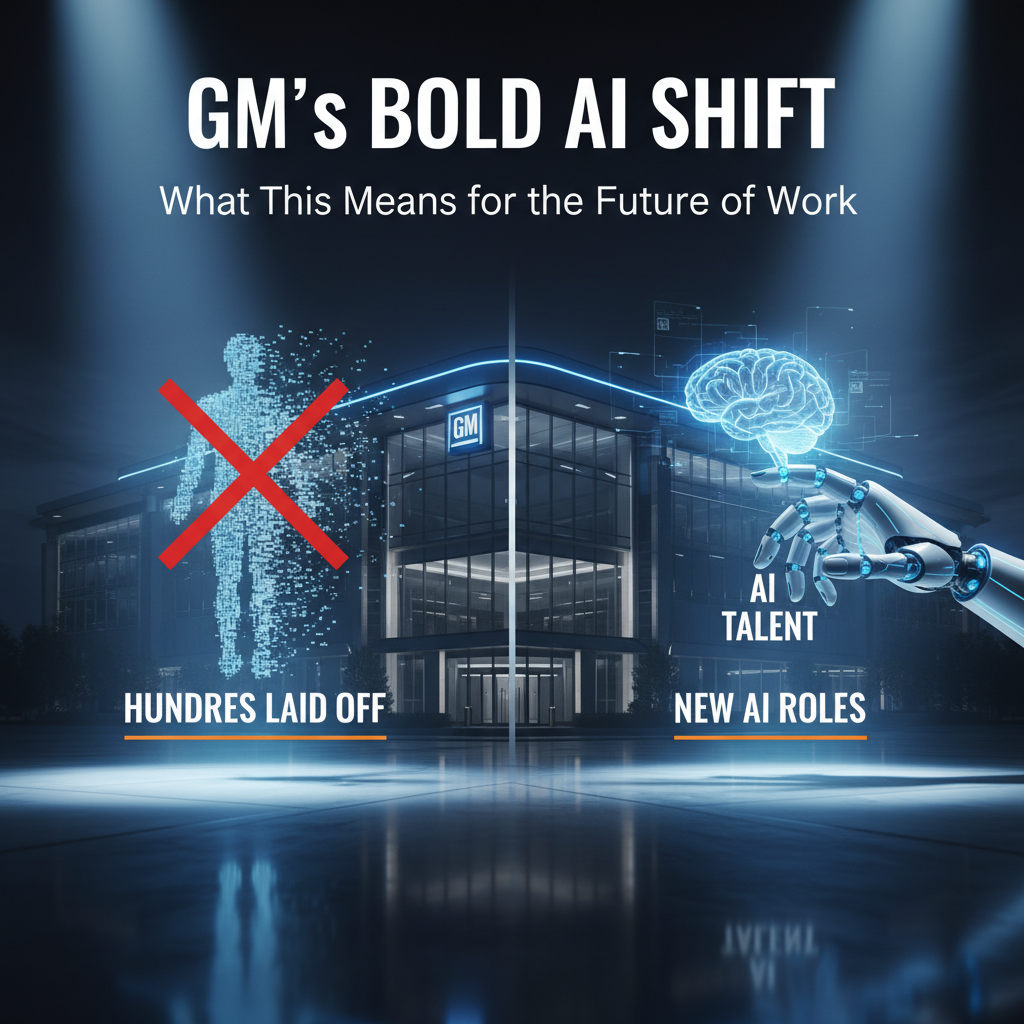
The landscape of global industry is undergoing a seismic shift, driven by the relentless march of artificial intelligence. In a move that reverberates far beyond the automotive sector, General Motors (GM) recently announced the layoff of hundreds of its IT workers, simultaneously signaling a robust push to hire individuals with stronger AI skills. This isn’t merely a corporate restructuring; it’s a stark bellwether for the future of work, illuminating the critical importance of adapting to an AI-driven economy.
GM’s decision underscores a fundamental truth: AI is no longer a futuristic concept but a present-day imperative transforming every facet of business, from manufacturing to customer experience. For professionals across all industries, understanding this shift and proactively acquiring in-demand AI skills is paramount for career resilience and growth.
The Driving Force Behind GM’s Strategic Pivot: Why AI is Indispensable
GM, like many legacy corporations, is in a race to redefine itself for the digital age. The automotive industry is particularly susceptible to AI disruption, with advancements in:
- Autonomous Driving Technologies: Requiring complex machine learning algorithms and vast data processing capabilities.
- Electric Vehicle (EV) Development: Optimizing battery performance, charging infrastructure, and smart energy management with AI.
- Connected Car Ecosystems: Enhancing user experience, predictive maintenance, and personalized services through AI-powered analytics.
- Manufacturing and Supply Chain Optimization: Using AI for efficiency gains, predictive quality control, and reducing waste.
To compete effectively, GM needs a workforce equipped to develop, implement, and maintain these sophisticated AI systems. This demand for specialized AI talent has superseded some traditional IT roles, highlighting a crucial workforce transformation.
From Legacy IT to Cutting-Edge AI: The Shifting Skillset Demand
While foundational IT functions remain vital, the nature of IT work is evolving. GM’s pivot illustrates a shift from generalist IT support and maintenance to highly specialized roles in:
- Machine Learning Engineering: Building and deploying AI models.
- Data Science: Analyzing complex datasets to extract insights and inform AI development.
- AI Architecture and Strategy: Designing scalable AI systems and integrating them into business processes.
- Prompt Engineering: Optimizing interactions with large language models and generative AI tools.
- AI Ethics and Governance: Ensuring responsible and fair AI development and deployment.
These are the stronger AI skills that companies like GM are now aggressively pursuing.
The Human Cost and the Call for Reskilling: Navigating the AI Layoffs
The news of GM AI layoffs is undoubtedly challenging for the affected IT workers. It serves as a stark reminder of the need for continuous professional development. However, it also presents an opportunity for individuals to re-evaluate their career paths and embrace reskilling and upskilling initiatives.
Governments, educational institutions, and employers have a shared responsibility to support this transition. Programs focused on teaching AI fundamentals, data science, and machine learning can help bridge the skills gap, turning job displacement into an opportunity for career reinvention.
Opportunities Abound: The Booming Demand for AI Talent
While some roles are being phased out, the demand for AI talent is skyrocketing across virtually every sector. Companies are grappling with a shortage of skilled professionals who can harness AI to drive innovation, improve efficiency, and create new products and services.
For those looking to enter or transition into the AI field, the prospects are bright. Online courses, bootcamps, certifications from leading tech companies, and university programs offer pathways to acquire these valuable skills. Building a portfolio of practical projects is also crucial for demonstrating competence.
Beyond Automotive: Industry-Wide Implications of the AI Revolution
GM’s actions are not an isolated incident; they are a microcosm of a global phenomenon. Similar shifts are occurring in:
- Healthcare: AI for diagnostics, drug discovery, personalized treatment plans.
- Finance: Algorithmic trading, fraud detection, customer service bots.
- Retail: Personalized marketing, supply chain optimization, inventory management.
- Manufacturing: Smart factories, predictive maintenance, automation.
Every industry is grappling with how to integrate AI effectively, creating a universal demand for a workforce proficient in AI technologies.
Preparing for the Future of Work: Actionable Steps for Individuals and Organizations
Navigating the AI revolution requires proactive strategies from both employees and employers:
For Individuals:
- Assess and Adapt: Evaluate your current skillset against the evolving job market. Identify areas where AI skills are becoming crucial.
- Invest in Learning: Pursue online courses, certifications (e.g., from Google, Microsoft, IBM), bootcamps, or formal education in areas like machine learning, data science, and prompt engineering.
- Embrace Lifelong Learning: The pace of technological change demands continuous learning and adaptability.
- Network: Connect with AI professionals, attend industry events, and seek mentorship.
For Organizations:
- Strategic Workforce Planning: Proactively identify future skill needs and implement internal reskilling programs.
- Foster an AI-First Culture: Encourage experimentation, education, and ethical AI development across all departments.
- Support Transitions: Provide resources, training, and career counseling for employees impacted by technological shifts.
- Collaborate: Partner with educational institutions and industry experts to develop relevant training programs.
Conclusion
GM’s decision to lay off IT workers in favor of those with stronger AI skills is a powerful signal of the current industrial paradigm shift. It underscores that AI is not just augmenting human capabilities but fundamentally reshaping job roles and organizational structures. While challenging for some, this transition opens up immense opportunities for those willing to adapt and acquire the in-demand expertise.
The AI revolution is well underway, and companies that embrace it strategically—by investing in the right talent and fostering a culture of continuous learning—will be the ones to thrive. For individuals, the message is clear: the future of work demands an active engagement with artificial intelligence, transforming potential disruption into powerful opportunity.